Featured Minor correction with major impact on spine
If the neck can be realigned as a result of a spinal operation, the effects can be positive on the whole cervical spine. This has been shown in a study by our spine team.
Neck issues rarely affect one isolated area. If the spine is out of balance, the whole body responds. The posture and muscle activity change, with other parts of the spine having to work harder to compensate for the affected areas not pulling their weight. This is the case, for example, when the intervertebral discs are worn down or bone spurs form on the spine in old age. This compensation effect on areas that were previously unaffected can actually end up causing further issues. In the worst case, it could cause wear there too.
Our new study shows that a targeted intervention on minimal vertebrae in the cervical spine can reduce this compensation effect in areas that are not being operated on and restore balance overall.
Stabilising a leaning tower
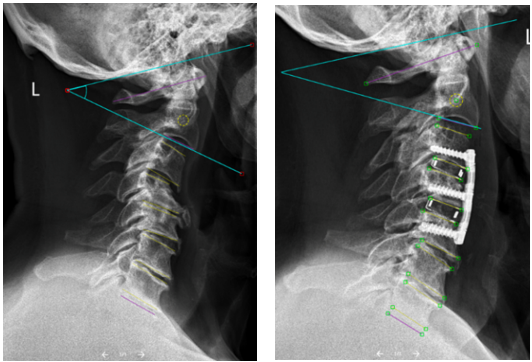
The study examined X-ray images of patients who had anterior operations on multiple adjacent areas of the cervical spine. Surgeons removed worn intervertebral discs, corrected the relative positioning and screwed affected vertebrae together to ensure stability.
The results speak for themselves. After the procedure, the neck returned towards its natural alignment – and not just in the area that was operated on. Results were also seen in the adjacent areas of the spine that were not involved in the surgery. One particularly exciting insight reveals improvements to the transition from the cervical to the thoracic spine too. This area is key to posture and stability. Easing this area means that the load is distributed more favourably and the body doesn’t have to compensate so much.
Just think about a leaning tower. If one part is out of alignment, the other parts have to bear more weight. Targeted interventions would make the entire structure more stable. For patients, that would mean their muscles wouldn’t have to work as hard to keep the body upright.
Accurate analysis with AI
For their analysis, the research team used x-ray images from the Schulthess Klinik’s own comprehensive radiological database. Images showing 298 patients before and after their operations were examined. They used an AI tool developed in-house, which automatically measures the alignment of the cervical spine with speed and precision. This study is the first time this tool has been used in a clinical setting.
More guidance for surgical planning
The results are relevant to surgeons as well as the patients directly. The study outlines a clear, three-stage analytical framework for surgical planning. The key is to look at the bigger picture, taking into account the cervical spine as a whole rather than just focusing on the area being operated on. This approach allows for more precise planning, with the aim always being to deliver the best-possible results.
Research that builds knowledge
This study is the result of international collaboration. Dr. med. Marco Manzetti made a key contribution to the study while working at Schulthess Klinik for several months on an AO Spine Fellowship. As one of five AO Spine Centres in Switzerland, Schulthess Klinik is actively committed to furthering research, teaching and training in spinal surgery. Prof. Dr. med. Markus Loibl, Head of Spine Surgery, is also Education Officer at AO Spine, making him responsible for education in Europe and Southern Africa.