Featured 20 years of shoulder registry: from a pioneering project to a valuable source of knowledge
Twenty years ago, Dr. med. Hans-Kaspar Schwyzer began systematically documenting shoulder prosthesis surgeries at the Schulthess Klinik. Thousands of cases later, this amount of data now provides unique insights for research and treatment. Together with his successor, Prof. Dr. med. Markus Scheibel, who now continues the project with his team, Hans-Kaspar Schwyzer reflects in this interview on the early days, the development, and the years of collaboration.
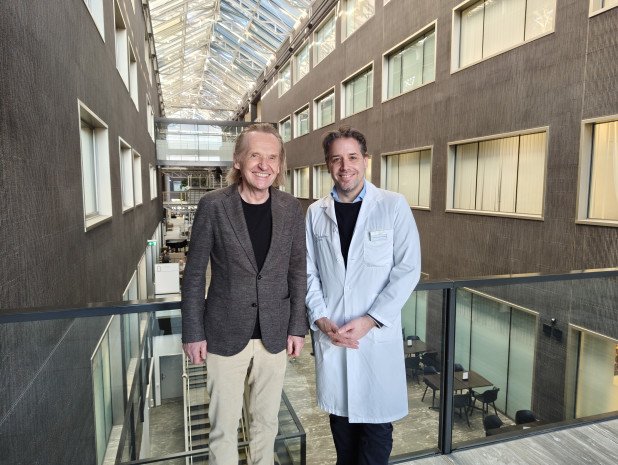
Dr Schwyzer, take us back to the beginning: How did the idea of establishing a shoulder registry come about over 20 years ago?
Hans-Kaspar Schwyzer: The fundamental question was actually quite simple: how good are our outcomes – immediately after surgery, in the medium term, and in the long term? Every orthopaedic surgeon wants to know what benefit an operation truly brings to the patient. Has the procedure reduced the pain? Has it improved the quality of life? And what influence do comorbidities or pre-existing conditions have on the course of treatment? To answer such questions, data are required – and that is how the idea of collecting them in a registry emerged.
What exactly is a registry?
Hans-Kaspar Schwyzer: A registry systematically records data on specific procedures and treatments. At the Schulthess Klinik, we saw our shoulder patients at regular intervals in our outpatient clinic. This long-term and close follow-up allows us to track how treatments and implants perform over the years.
Building such a database must be quite resource-intensive…
Hans-Kaspar Schwyzer: Yes, not only in terms of personnel, but also financially. We are talking about investments of around one million Swiss francs. This was made possible by the support of the Georg and Bertha Schwyzer-Winiker Foundation. Without this funding, the project would not have been feasible at the time.
Professor Scheibel, you are Hans-Kaspar Schwyzer’s successor and now continue the registry. What data do you collect exactly?
Markus Scheibel: In orthopaedics, we regularly assess the cardinal symptoms of pain, loss of strength, and functional impairment, which often reduce the quality of life. Even 20 years ago, prostheses enabled us to achieve significant improvements in these areas. Analysis of the registry data has allowed us to fine-tune our treatments – meaning more precise indication setting, improved implants, and less invasive surgical techniques. This has enabled us to further optimise almost all of these parameters. In short, overall treatment quality has improved. In addition, the collected data show us how long different prostheses last and whether they function reliably over many years.
Can you give an example?
Markus Scheibel: Sure. In 2025 we published a study in which, thanks to the data, we were able to determine that a particular prosthesis loosened significantly more often at an early stage than others. Because patients were followed up regularly, we were able to identify this clustering. Without the registry, it would likely have gone unnoticed.
And what happened then?
Markus Scheibel: We informed the manufacturer – most of the implants used are no longer available on the market today.
Hans-Kaspar Schwyzer: That is precisely what a registry is for: to observe objectively, identify problems early, and respond before greater harm occurs. It functions like an early warning system.
Markus Scheibel: This study was also included in the list of the world’s top 10 publications of 2025 by the renowned journal Journal of Bone and Joint Surgery. This underlines the importance of the work and highlights how crucial it is to publish even suboptimal results transparently for the benefit of future patients.
How has shoulder arthroplasty changed over the past 20 years?
Markus Scheibel: Over the past 20 years, diagnostics have become significantly more precise. Greater attention is now paid to joint function, surrounding tissue, and the expected longevity of the prosthesis. In addition, modern implants are positioned in a way that removes as little bone as possible and better matches the patient’s individual anatomy. Three-dimensional planning has improved surgical preparation, and robotics will further increase precision in the future.
Hans-Kaspar Schwyzer: We were also able to show that the reverse prosthesis is by no means merely a «second choice »…
Reverse shoulder prosthesis?
Markus Scheibel: This is an artificial joint in which the ball and socket are deliberately reversed. The ball is attached to the shoulder blade, and the socket to the upper arm – exactly the opposite of the natural anatomy. Initially, this design was considered a last-resort solution among orthopaedic surgeons. However, our registry showed a trend towards the reverse prosthesis very early on, much earlier than in many other countries. The data demonstrated that we could often achieve equally good or even better outcomes with it. Today, the reverse prosthesis is firmly established.
Where does the registry stand today – and what comes next?
Markus Scheibel: We are continuously integrating new technologies into our data collection, such as preoperative 3D planning. In addition, we are combining our data with registry data from leading institutions such as the Hospital for Special Surgery (HSS) to carry out joint research projects. A key research focus is personalised medicine – in other words, determining which implant configuration is best suited to the individual patient. One ongoing challenge, however, is long-term follow-up: after 20 years, some patients have passed away or are no longer mobile. In the long term, we therefore need to develop new ways to maintain contact with patients outside the clinic.
Hans-Kaspar Schwyzer: Today, a registry is simply an integral part of responsible orthopaedics. It is not a luxury, but a prerequisite for accountable medicine.
Dr. Schwyzer, one final question: Did you anticipate 20 years ago the scale this registry would eventually reach?
Hans-Kaspar Schwyzer: To be honest, I did not expect it to produce such far-reaching scientific and practical results. As a surgeon, one always hopes there will never be complications – but when problems do arise, this registry allows us to respond and act in a completely different way. That is something I am very pleased about.
Markus Scheibel: And we are not at the end yet. Twenty-year data are rare worldwide. I am convinced that we will gain many more important insights from them.