Excellence and quality
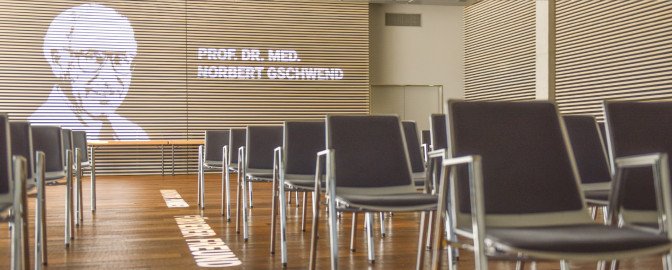
Systematically embedded excellence
At Schulthess Klinik, quality is not a one-off project, but a systematic, ongoing commitment. For us, quality means providing every patient with the most effective treatment possible, thereby restoring their quality of life. Our system, in which the treatment of patients and research work hand-in-hand, is a key foundation for the very high standard of care we provide. Questions arising from everyday clinical practice are investigated from a scientific viewpoint and the findings are incorporated directly into the treatment of patients. Thanks to our high case volumes and the specialisation of our departments, our medical teams have extensive experience and expertise.
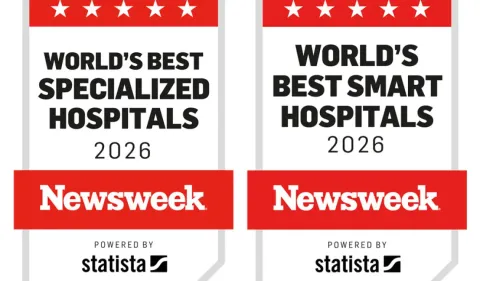
This quality has once again been confirmed by the “World’s Best Specialized Hospitals 2026” and “World’s Best Smart Hospitals 2026” rankings. In the latest hospital ranking by the renowned US Newsweek magazine and the Statista research institute, Schulthess Klinik remains the top specialist orthopaedic clinic in Switzerland and number 2 in Europe. Schulthess Klinik ranks sixth globally.
Measurable quality
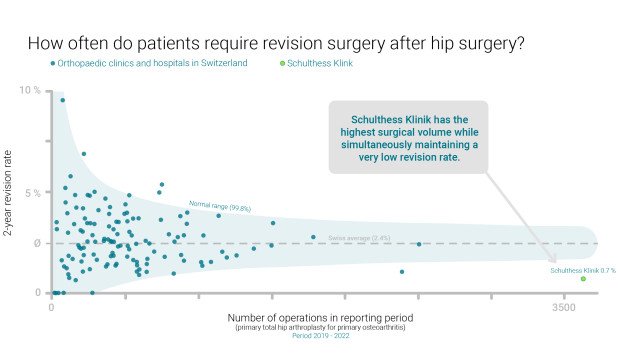
One of the most reliable quality indicators is the revision rate following hip and knee replacements. This key figure shows how often patients need to undergo a further operation after initial surgery and thus enables us to form an objective assessment of the quality of treatment provided by hospitals. Low revision rates mean fewer complications, a faster recovery and a quicker return to day-to-day life.
The Swiss National Association for Quality Development in Hospitals and Clinics (ANQ) records these revision rates on an ongoing basis for all Swiss hospitals. In this comparison, Schulthess Klinik has been one of the best in Switzerland for years. Every year, our specialist surgeons perform around 1,300 hip and 1,100 knee replacements. In the most recent evaluation period, only 0.7% of patients required a repeat hip operation and 1.6% a repeat knee operation. By way of comparison, the Swiss average is 2.5% for hip replacements and 3.3% for knee replacements (2025 SIRIS report, evaluation period 01/01/2019 to 31/12/2022).
Very high patient satisfaction
Another key indicator of the quality of our treatment is patient satisfaction. In our ongoing patient survey, 90% of our inpatients rated their overall satisfaction at the highest level in 2025. Particular emphasis was placed on medical care: 93% said the medical care they experienced was “very good”. Nursing care and physiotherapy also received excellent feedback.
Integrated management system
Since 2017, the hospital has been ISO 9001:2015 certified and thus has a structured quality management system with clear areas of responsibility, standardised processes and an established improvement cycle. We also hold ISO 14001 certifications for environmental management and work-family balance. Together, these form an integrated management system that combines quality, sustainability and social responsibility.
Quality is an integral part of the organisation at Schulthess Klinik, is externally audited and continuously developed. It is systematically put into practice by our staff every day, ensuring that every patient benefits from consistent, demonstrably first-class care.
Cooperations: networking for quality
Excellent medicine is not achieved in isolation. This is why Schulthess Klinik has built up a network of over 60 national and international partners from clinical practice, academia and specialist medical services. This networking strengthens professional exchange, promotes innovation and helps to continuously improve treatments.
Together, we are committed to research and teaching, to the training and further education of medical and nursing staff, and to cross-hospital care models. This is how we achieve quality through dialogue, underpinned by knowledge, experience and partnership. Because close cooperation benefits patients.
Excellence in an international network
An important milestone in 2025 was the signing of the cooperation agreement with the Hospital for Special Surgery (HSS) in New York. The HSS has long been regarded as a leading international centre for orthopaedics. The cooperation has clear objectives: the systematic exchange of knowledge and experience, joint research projects and training and continuing education programmes, as well as cooperation on technological issues.
A particular focus is on outcome research. Based on clinical registries from both institutions, we systematically analyse treatment outcomes using new technologies such as apps, wearables, motion analysis and artificial intelligence. Based on these findings, we continuously review treatments, develop them further and increasingly personalise them. Strategically, the partnership strengthens Schulthess Klinik’s positioning as an internationally networked specialist hospital on a par with the world’s leading reference centre for orthopaedics.
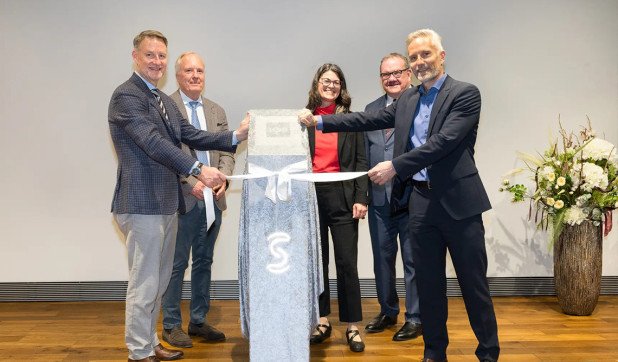
Pictured (from left to right):
Ernest L. Sink, MD, Paediatric Orthopaedic and Hip Preservation Surgeon, HSS
Prof. Dr. med. Michael Leunig, CMO, Departmental Head of Hip Surgery, Schulthess Klinik
Prof. Dr. habil. Annegret Mündermann, PhD, Chair of Research, Schulthess Klinik
Daniel W. Green, MD, MS, FAAP, FACS, Paediatric Orthopaedic and Sports Medicine Surgeon, HSS
Rodolphe Eurin, Director and CEO, Schulthess Klinik
Charité Berlin’s “Academic Cooperation Hospital”
A strategic partnership with the Charité – Universitätsmedizin Berlin hospital has been in place since July 2024. The partnership promotes the joint further training of doctors and researchers and establishes a clearly structured academic career path.
As part of this cooperation, both institutions aim to undertake joint projects in research and its translation, i.e. implementing scientific findings into patient care.
Strategic research partnership
Networking is also crucial in science and innovation. As a strategic partner of ETH Zurich, Schulthess Klinik operates at the interface of medicine, technology and data science. Joint research projects promote new technologies and evidence-based therapies – with a clear focus on measurable patient benefits.
How we put quality into practice in everyday life
A few examples from various departments within the clinic illustrate how our commitment to continuously improving the quality of care for our patients is reflected in our day-to-day work.
Nursing: fewer interruptions, more time for patients
Nursing brings many different strands together. It serves as the central point of contact between patients, doctors and numerous other departments in the hospital. At the same time, frequent queries and phone calls lead to interruptions that take up valuable time. New digital dashboards mean that nurses have more time to care for patients.
To significantly ease the burden of day-to-day nursing work, in 2025 we introduced a digital dashboard for patient overviews, visible on screens in a management office and in the ward rooms. The aim was to make relevant information available centrally and promptly to all relevant professional groups.
The dashboard draws on existing systems, such as bed planning and staff scheduling. Information is entered once and immediately becomes available where it is needed. The various departments receive the information that is relevant to them specifically, such as whether a room can be cleaned or whether a planned admission has been postponed.
This eliminates the need for numerous phone calls and queries. This has resulted in processes becoming more transparent, decisions being made faster and day-to-day care being noticeably calmer. Fewer interruptions and clear lines of responsibility allow nursing teams to focus more on their core task: caring for patients. The time saved directly benefits quality and safety – an important step towards the Silent Hospital concept with clear processes and the highest quality of care.
Facility management: quality in the background
A wide range of professional groups work hand-in-hand in the field of facility management: housekeeping, reception, room service, kitchen, technology, catering and event organisation. With their services, they all support medical processes and make patients’ stays as pleasant as possible.
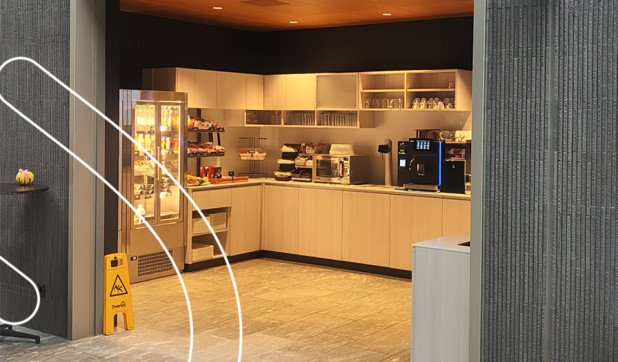
In 2025, we opened our “SelfBar”: an easy-access catering service available around the clock. Patients, visitors and employees can get hot and cold drinks, snacks, kiosk items and homemade products such as meals, salads and pastries at any time – regardless of the opening hours of our restaurant and bistro or the room service operating hours.
Sustainability was a key guiding principle in the planning of the SelfBar. Packaging, materials and the range of items were selected in such a way as to ensure quality, reduce food waste and conserve resources. These include disposable cutlery made from certified natural materials, the elimination of disposable cups and the ongoing adjustment of supply to actual demand.
Radiology: well prepared, better looked after
In 2025, our Radiology team worked intensively on a project designed to improve quality in an area where it is most noticeable to patients: during preparation for an examination. Patients are now given important information in the changing room immediately before the examination. As soon as they are called up via the ticket system and enter the changing room, a short video starts automatically. This clearly explains what examination they are about to undergo, how it is carried out and what to bear in mind, for example regarding radiation protection, a possible pregnancy or which items of clothing and jewellery need to be removed. The videos are available in four languages.
This ensures that patients enter the examination room well prepared. Queries and uncertainties are reduced, making the process calmer and more efficient. This is a benefit for both patients and staff, which, following the planning and preparation that took place last year, will be felt from 2026 onwards.
Operating theatre management: precision through teamwork and technology
High-quality surgical care is the result of a combination of experience, teamwork and state-of-the-art facilities. The surgical team comprises three different professional groups – surgical nursing, anaesthesiology and patient positioning – with a total of 92 full-time positions.
In 2025, Schulthess Klinik invested in new equipment in operating theatres in order to further improve established processes, introduce innovative surgical techniques and perform surgical procedures with even greater precision and safety. A crucial aspect here is that state-of-the-art technology only realises its full potential through the seamless collaboration of the operating theatre team and the Surgery and Anaesthesiology departments. Clear processes, defined roles and close coordination are central. The specialised operating theatre nursing teams played a key role in ensuring that the new procedures were safely integrated into everyday operations.
The investments included five new operating tables (Maquet Corin by Getinge). This new generation of operating tables improves both patient safety and working conditions in the operating theatre. Thanks to modern sensor technology and the operating tables’ integrated safety features, operations are safer. Precise adjustability allows patients to be positioned gently. This reduces pressure on the tissue and ensures better recovery after surgery. At the same time, automated processes and predefined settings reduce preparation times.
This also has benefits for the operating theatre team as the integrated motor makes it easier to reposition patients and noticeably reduces physical strain. An intuitive control system supports a calm, structured workflow, allowing the team to focus on what matters most: the safe care of our patients.
Our experts
Excellent medicine begins with the people who make it possible. Our doctors are among the world’s leading specialists in their field – recognised for their expertise, experience and contribution to cutting-edge medicine.
Team achievements and promotion of early career researchers
Numerous awards and prizes at the German, Austrian and Swiss Shoulder and Elbow Society (DVSE) conference:
- Alwin Jäger Video Prize for resident Christina Julia Lorenz and other co-authors from Schulthess Klinik
- Perthes Prize for Dr. med. Sebastian Lappen, whose award-winning publication was produced as part of a fellowship at Schulthess Klinik and co-authored by Prof. Dr. med. univ. Philipp Moroder
- Research funding for Dr. med. David Endell on a research project focusing on biceps tissue with other co-authors from Schulthess Klinik
Significant presence of the Hand Surgery team at the Congress of the Swiss Society of Hand Surgery (SGH) and the Swiss Society for Hand Rehabilitation (SGHR) with 18 presentations and moderated sessions.
There was a particular focus on promoting early career researchers: the Golden Hand Award went to a team consisting of staff from Schulthess Klinik, University Hospital Zurich and Balgrist University Hospital. The team included Michael Wirth, a resident at the time, and Laima Bandzaite, a former resident and future consultant with us.
Strong presence of the Hand Surgery team at the FESSH Congress in Helsinki with numerous presentations, two “Most Cited Paper Awards” (Journal of Hand Surgery (European Volume)) for particularly frequently cited work on the Touch prosthesis for the thumb carpometacarpal joint and second place in the Shark Tank Competition for our PhD student Luca Häfliger
Strong representation of our Spine team at the AO Spine congress in Davos as speakers and participants
Great commitment from the Knee Surgery team in surgical technique and robotics:
- first use of the Attune Medial Stabilized Knee System from Johnson & Johnson in Europe (Prof. Dr. med. Michael Worlicek) and first use of the Persona® Revision system in Switzerland (Dr. med. Gregor Baumann)
- Several presentations and live surgeries by our Knee Surgery team using robotic systems such as ROSA and VELYS or the Persona® Revision system at various congresses, including the Endoprosthetics Congress in Berlin, the Summit of the World Surgery Tour, the AO Davos Courses and the Swiss Orthopaedics Annual Congress
Personal awards and milestones
- Election of Prof. Dr. med. Markus Scheibel as President of the European Society for Surgery of the Shoulder and Elbow SECEC/ESSSE for the term 2026 to 2028
- Postdoctoral qualification for PD Dr. med. Florian Freislederer at Charité Berlin, with which Schulthess Klinik is in close cooperation, on the topic of “Optimising outcomes after reverse total shoulder prosthetics in defect arthropathy”
- Title of “Giant of Hand Surgery”, one of the highest honours in the field of international hand surgery, for Dr. med. Daniel Herren
- Honorary membership of the British Society for Surgery of the Hand, one of the largest professional associations for hand surgery in Europe, for Dr. med. Daniel Herren
- Postdoctoral qualification for PD Dr. phil. Miriam Marks at ETH Zurich: “Outcome measurement in hand surgery: What is important to patients?”
- Prestigious ISSLS Wiltse Lifetime Achievement Award for Prof. Dr. med. Jiri Dvorak, conferred by the International Society for the Study of the Lumbar Spine (ISSLS) and the US Spine Journal
- Election of Dr. med. Raluca Reitmeir as representative of all neurosurgeons in Switzerland within AO Spine Switzerland
- PhD title for Dr. med. Jani Puhakka at the University of Helsinki
- Swiss Spine Society Award of Excellence for Dr. med. Gregor Fischer
- Dr. med. Christian Egloff appointed as Titular Professor of Orthopaedics and Traumatology at the University of Basel for his outstanding achievements in research and teaching as well as his long-standing commitment to clinical training