Hip Surgery
Annual report 2025

Specialisation, experience and evidence-based surgical technique
The Hip Surgery department at Schulthess Klinik is characterised by a high degree of specialisation, a high case volume and standardised procedures. This creates a stable basis for consistently excellent treatment results. At the same time, we are continuously developing our surgical techniques on the basis of scientific evidence and with the clear aim of improving the quality of life of our patients in the long term.
Highest case volume and exceptionally low revision rate
A key quality indicator in hip surgery is how often further surgery is necessary within the first two years after a hip joint replacement. This is referred to as the two-year revision rate.
The Swiss National Association for Quality Development in Hospitals and Clinics (ANQ) continuously records the revision rate for all Swiss hospitals in the SIRIS report. The 2025 report (evaluation period 01/01/2019 to 31/12/2022) shows an adjusted two-year revision rate for Schulthess Klinik of 0.7%. The Swiss average is 2.4%. This means that our patients need a second operation over three times less frequently than the national average. “Adjusted” means that differences in the patient profile, such as age, sex or comorbidities, are taken into account statistically. This makes it possible to compare results fairly across hospitals.
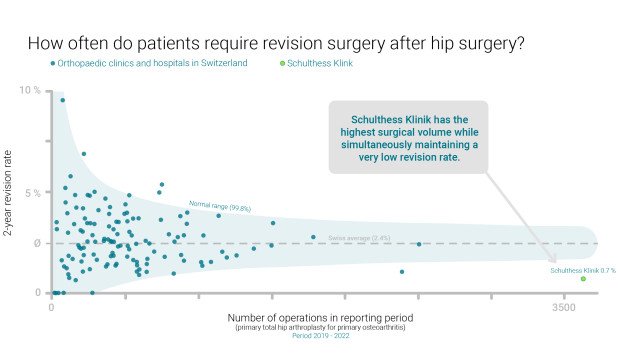
The evaluation is based on 3,633 hip replacements recorded in the registry. This means that Schulthess Klinik has the highest number of cases compared to the Swiss centres listed. Its high level of specialisation and many years of experience significantly contribute to this consistently low revision rate.
Proven technology: further confirmed scientifically and in international demand
Schulthess Klinik has been using the “bikini” approach to hip replacement for many years. The incision follows the skin’s natural tension lines. This results in a discreet scar and allows for minimally invasive access to the hip joint.
This proven technology received new scientific confirmation in 2025. A recent study showed that “bikini” access not only improves the cosmetic healing of the skin, but also protects important muscles and a central blood vessel that supplies the surrounding muscles. As a result, muscle health is better maintained, swelling and discomfort are reduced, while the safety of the procedure remains high.
For about ten years, the Hip Surgery department has complemented this surgical technique with frame-based surgical draping, which facilitates precise work. The surgical area is prepared in a standardised manner using a frame system. The latest scientific publication also confirms this approach as efficient and safe.
The “bikini” technique developed at Schulthess Klinik is being used increasingly around the world. A video of the operation was one of the most downloaded contributions in the Journal of Bone and Joint Surgery in 2025 and underscores the international interest in this method.
For our patients, this means a sparing intervention and excellent long-term results based on experience, standardisation and scientific evidence.