Paediatric Orthopaedics
Annual report 2025
Responsibility from the start
Children are not small adults. Growth, development and long-term prospects require particularly careful decisions, both medically and on a human level. In the Paediatric Orthopaedics department, we combine specialised expertise with interdisciplinary cooperation and a clear focus on the future of our young patients.
Courage to amputate
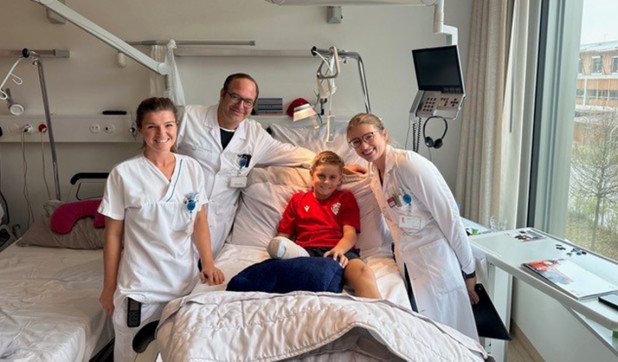
Sometimes good medicine means making a difficult decision. Nine-year-old Ilai from Canton Valais was born with a severe defect in his right leg. His entire shinbone was missing, making the lower leg non-functional. For years, he was fitted with a complex orthopaedic prosthesis, combining support with replacement of the malformed leg. Various reconstruction options, involving up to 20 operations, countless hospital stays and uncertain functional outcomes, were discussed as possible treatments. After intensive and very personal discussions with Ilai and his family, we made a joint decision to amputate the non-functioning lower leg.
What may have seemed radical at first was ultimately the most compelling solution, both medically and functionally. With a single operation and state-of-the-art prosthesis technology, we achieved an excellent outcome. We performed the operation together with an internationally renowned specialist. For Ilai, just a few months after the operation, this now means new freedom of movement and clear future prospects above all.
Knee surgery for young athletes
The number of knee joint operations in children and adolescents has increased significantly over the past three years. This mainly affects internal knee injuries, such as cartilage damage, meniscus injuries and cruciate ligament tears. The injured children and adolescents very quickly gain access to our special consultations, so immediate and targeted action can be taken.
Precise diagnostics are crucial, especially for children who are still growing. Together with the Radiology, Physiotherapy, Sports Medicine and Knee Surgery departments, we carefully assess whether an operation is necessary or if another treatment will suffice. The aim is not to overlook injuries or perform unnecessary operations, but to ensure the long-term stability and functionality of the knee.
Early detection and correct examination of malformations
Quality of treatment often starts with early detection. The annual “Hip dysplasia and infant hip ultrasonography” course focuses on the question of how hip malformations can be detected as early as possible. Together with our specialists and Prof. Reinhard Graf, who developed the established examination procedure almost 30 years ago, we convey current knowledge in lectures, case studies and practical exercises.
We have also been organising the annual paediatric orthopaedic examination course for about 15 years now. The course takes place in conjunction with Kinderärzte Schweiz, the professional association for paediatricians in Switzerland, and is very popular with participants due to how interactive it is.
This enables paediatricians to gain confidence in diagnostics and initiate the most appropriate and least invasive possible treatment for affected children early on.