Featured Research for better treatment: Markus Loibl takes over as head of the Scientific Board
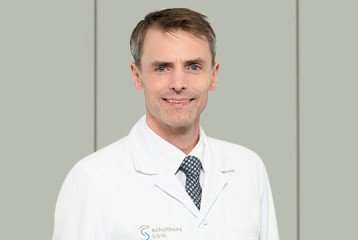
Prof. Dr. med. Markus Loibl, Consultant in Spinal Surgery, is taking over as Chair of the Scientific Board at Schulthess Klinik. In this interview, he explains how patients’ experiences drive research forward, what long-term treatment data enables, and what priorities he intends to set as the new Chair.
You are taking over as head of the Schulthess Klinik’s Scientific Board. What appeals to you personally about this role?
I am particularly drawn to the topic of ‘data’. At the Schulthess Clinic, we have taken the assessment of post-operative outcomes into our own hands using our own data. It was very forward-thinking to begin systematically collecting data from all patients undergoing surgery more than 20 years ago. This wealth of experience helps us to better understand the long-term effects of a treatment. As Chair, I would like to continue and intensify this approach across all departments.
What is a Scientific Board?
The Scientific Board brings together doctors and scientists. They contribute different perspectives but share a common goal: to further improve the care of our patients. We discuss issues arising from day-to-day clinical practice, plan what data we need for this and how we will analyse it. At the same time, it acts as a decision-making body: here, strategic decisions for or against innovative surgical techniques, implants and other treatment methods can be assessed at an institutional level.
Why does an orthopaedic clinic need a Scientific Board?
In an orthopaedic clinic, new surgical techniques are constantly being applied and implants fitted. It is crucial for our patients that these actually bring benefits. We must assess this carefully and independently. The Scientific Board provides a framework for this. This enables us to make sound decisions in the best interests of our patients.
What specific tasks does the Scientific Board undertake at the Schulthess Clinic?
The Board supports the research strategy of the Schulthess Clinic and the Schulthess Foundation – from deciding which topics we wish to investigate through to the implementation of specific projects. This encompasses research within the clinic as well as joint projects with our partners.
How does a question arising from day-to-day clinical practice become a research project, and how do the findings find their way back into clinical practice?
It often starts with a question raised during a conversation with a patient: Is an operation necessary? When is the right time? And which procedure offers the best prospects for this individual? We take such questions into our research. Using our systematically collected data, we investigate how people fare after treatment, and in doing so, we learn to question our own actions and adapt our treatment decisions.
How exactly do patients benefit from their clinic also carrying out research? Can you illustrate this with an example?
One example from spinal surgery is herniated discs. We now know that most cases can be treated without surgery. If a herniated disc recurs and a second surgical procedure is being considered, the decision is often challenging: which operation will help this person the most, and when does it make sense to proceed? Using our database, we have compared two surgical treatment options. In doing so, we look at both the treatment outcomes and potential complications. For patients, this means we can explain the benefits and risks of the various options using concrete figures and work together to make a decision that suits their situation.
The Schulthess Clinic has been systematically collecting data on its treatments for over 20 years. What makes this long-standing treasure trove of data so valuable for research?
Its great value lies in the fact that, over many years, we have consistently followed up with our patients to find out how they are getting on. This enables us to see whether a treatment is effective in the longer term. We have one of the largest databases in the world containing treatment outcomes collected over the long term. In spinal surgery, we follow up with patients at defined intervals for up to five years after their operation. This data collection has been ongoing for over 20 years. The combination of scope, systematic approach and many years of experience is a valuable asset. We are now building on this to develop models designed to predict treatment outcomes. Our aim is to be able to assess even more accurately in future which treatment can help which patient.
Using what are known as PROMs, patients themselves report on how they are feeling – for example, in terms of pain, mobility and quality of life. What do we learn from this that medical examinations alone do not reveal?
We need the patients’ own perspective. With PROMs – standardised questionnaires on pain, function and quality of life – we systematically bring these experiences to light. Because we ask about at fixed intervals, we can track changes over a longer period and compare results. The questionnaires complement the medical examinations. Once a patient’s condition has stabilised and face-to-face follow-up appointments are no longer necessary, we can continue to find out how people are doing via digital or paper-based questionnaires.
How does this feedback lead to concrete improvements in treatment?
The feedback shows us how a treatment affects people’s everyday lives. When we analyse the results of many patients with the same condition, we gain a better understanding of which treatment offers good prospects under which circumstances. In the case of recurrent herniated discs, for example, we have investigated how the outcomes relate to the chosen surgical procedure. Such insights help us to tailor our recommendations more precisely to the individual. The experiences of previous patients thus help to improve treatment for future patients.
Is there a specific example where such findings have led to changes in treatment or aftercare?
Yes, we have adapted our approach in cases of recurrent disc herniation. Our analyses show that, where certain changes are observed in imaging, it may be advisable to consider stabilising fusion surgery – known as spondylodesis – at an early stage. If only the herniated disc is removed, this does not provide long-term pain relief, and further surgery is likely to be required. These findings help us to assess more accurately which approach is likely to benefit which patients in the long term.
As the new head of the department, what priorities do you wish to set? Where do you see the greatest potential for the coming years?
For me, there are three key priorities. Firstly: building on all the groundwork already done, we will intensify our focus on data, automated image analysis and outcome prediction across all departments and pave the way for this. Secondly: we will become even more digital and further expand our infrastructure for systematic data collection across all departments. Thirdly: My aim is to expand our established partnerships and our network in order to carry out more joint multicentre projects. In this way, we will offer all colleagues engaged in scientific work at the Schulthess Clinic an ideal platform for carrying out projects that improve the quality of care for our patients.